



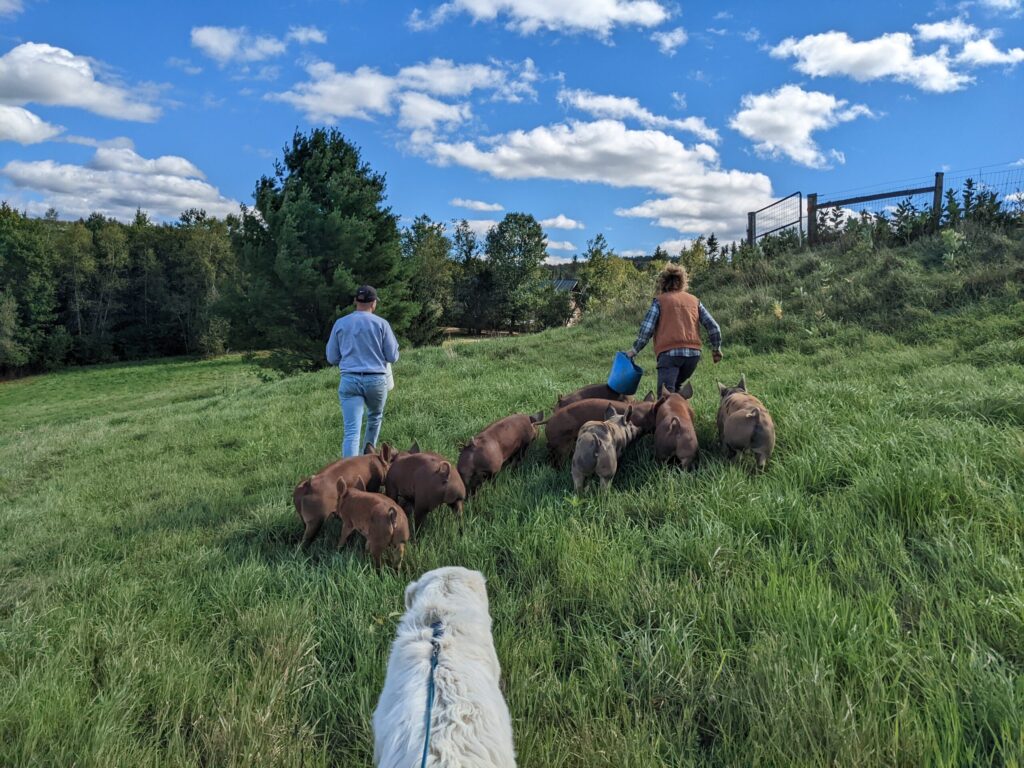
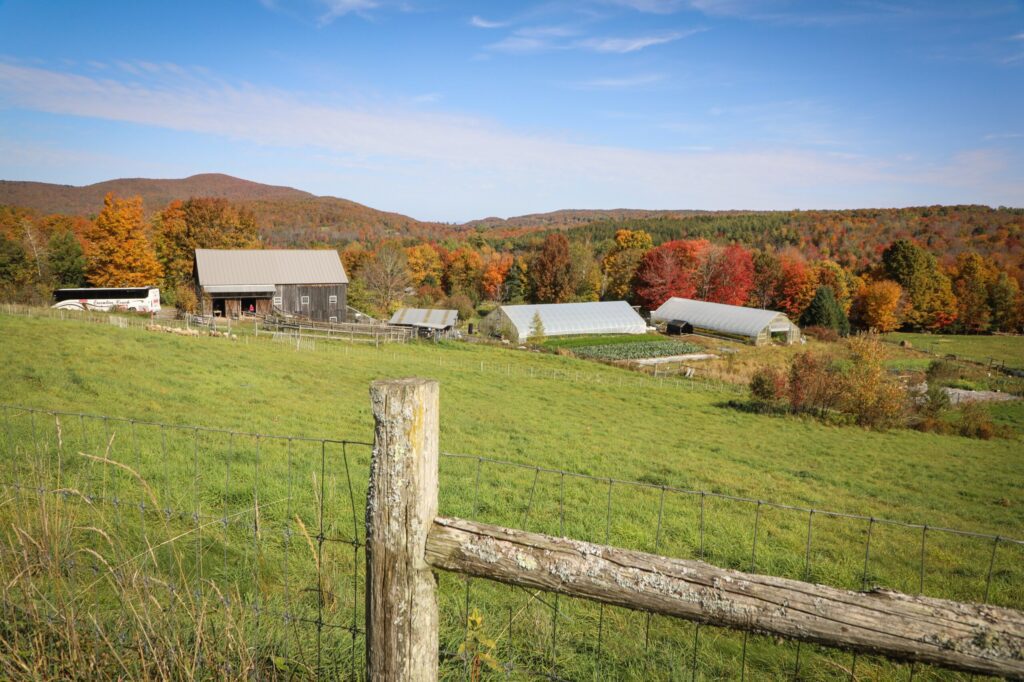
It’s early morning on Green Mountain Girls Farm, tucked away among the wooded hills of Vermont’s Washington County. Birds hop between fence posts, plucking bugs from dew-beaded spiderwebs. Wind ripples through the waist-high grass and pushes blush-pink clouds across the brightening sky. Fruit trees shiver their leaves. Pigs grunt contentedly in the rain-softened earth, while farmer Laura Olsen takes it all in with a smile.
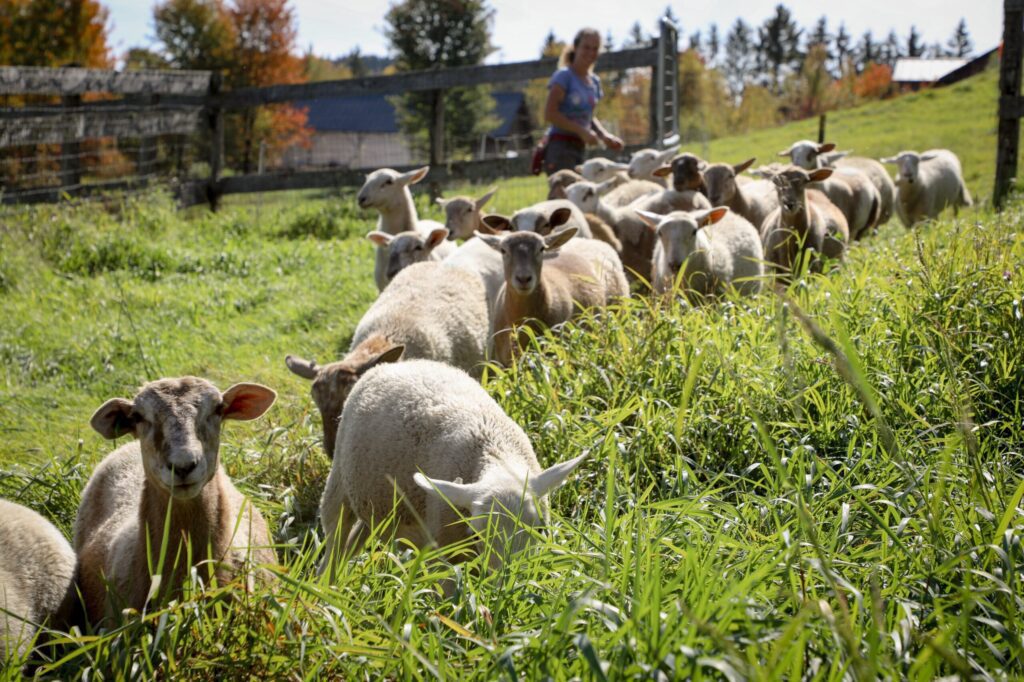
“My happy place is in the fields, when we’ve just moved the sheep into fresh pasture and I have a moment to slow down, pause and listen,” says Laura. “They’ve been calling because they know what’s coming, and then all of a sudden they go quiet, and there’s just the peaceful sound of them eating. It’s magical, and something I wish everyone could experience.”
For Laura, those slow-down-and-take-it-in moments are few and far-between — with 40 acres of farmland to manage, time is the most precious of commodities. But then, all good things take time — even revolutions.
Laura and her wife Mari founded Green Mountain Girls Farm together in 2007, inspired by Vermont’s famous Green Mountain Boys — the Revolutionary War militia whose fight for freedom helped shape America’s history. Laura and Mari wanted to borrow that same spirit of change for a different cause. “We felt there really needs to be a food revolution,” she says. “How we farm and how we eat really matters.”
“We wanted our lives to reflect what we cared about”
Laura didn’t grow up expecting to become a farmer. She and her partner Mari spent years working in conservation before returning to Vermont to build Green Mountain Girls Farm together. They were drawn back by a simple question: if they believed healthy landscapes mattered, shouldn’t their everyday lives reflect those values?
“We realized food touches everything,” Laura explains. “It touches our health, our communities, our environment, our economy. It felt like one of the biggest opportunities to make a difference. Really, we just wanted our lives to reflect what we cared about.” Today their farm raises heritage pigs, sheep, laying hens, turkeys, fruit and vegetables using regenerative farming methods designed to restore soil health while producing food that nourishes people.
“My wife and I both came from an environmental advocacy background. As we made a mid-career transition, we felt that how we raise food in this country is one of the most critical environmental issues of our time. We wanted to move into farming because how food is raised can be so hopeful, as well as delicious.”
Laura sees her vision for the future clearly — and she can personally attest to the transformative effect of properly-raised produce. After all, before her life on the farm, she’d been a vegetarian for more than twenty years.
“It’s the how, not the cow”
“I didn’t eat meat until we started raising our own”, she explains. “The reasons were almost entirely environmental. I felt the way we raised meat in the U.S. wasn’t good for the animals, for people or for the environment.” That belief hasn’t disappeared, but she’s realized that it’s not as simple as what you’re producing.
“It’s the how, not the cow,” goes her mantra. For her, sustainability isn’t determined by whether food comes from animals or plants, it’s simply in the way the land is managed: healthy pasture stores carbon; diverse fields support wildlife; animals grazing naturally improve soil rather than exhausting it. Poor farming practices, meanwhile, can damage ecosystems regardless of what’s being grown. “Farming well can address climate change,” she says. “The way we farm prioritises wellness and ecological health. Sometimes that feels like a luxury, but it also feels like a necessity.”
Returning to eating meat meant learning entirely new skills. “I had to learn how to cook it!” she laughs. Now she happily recommends a slow-roasted pork shoulder or grilled leg of lamb from animals raised on the farm. Those conversations happen naturally during Trafalgar’s Be My Guest experience, where visitors gather around the table to share a meal and ask questions about everything from regenerative agriculture to everyday life in rural Vermont.
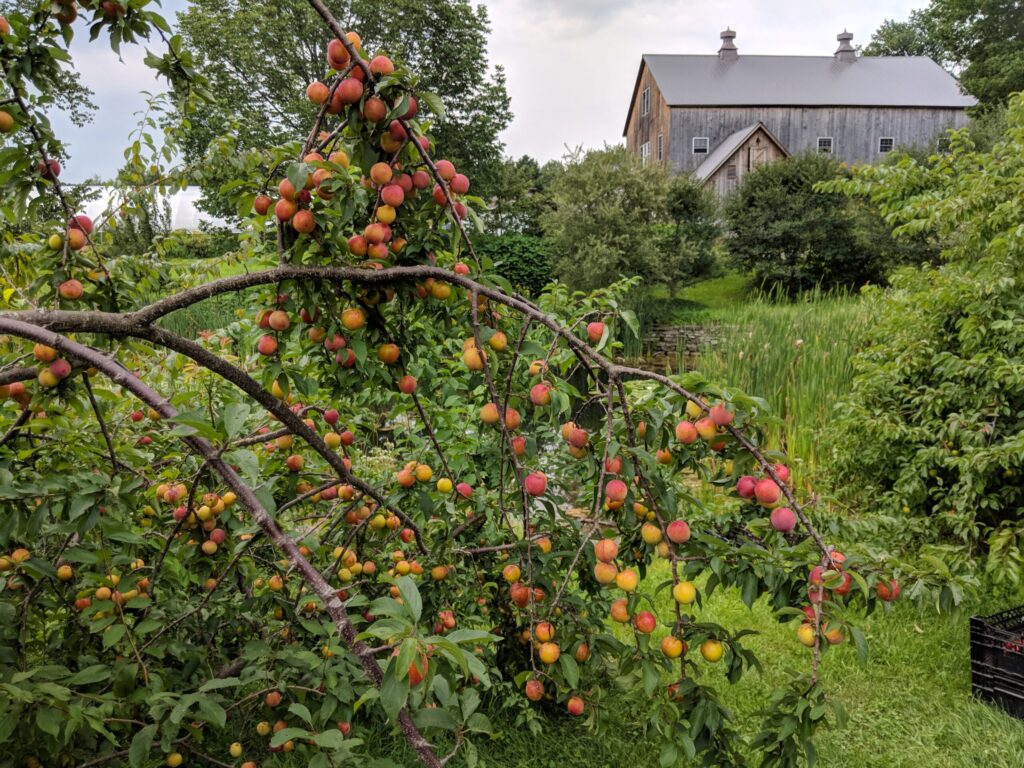
Food has a way of making complicated subjects feel approachable. “When people walk on our farm, when they see our animals grazing, when they stop to pick and taste something growing that’s so fresh, they get it.”
“You can see the light bulbs go on”
For a lot of guests who arrive on the farm, this is their first real taste of this lifestyle — and the opportunity that presents is what gets Laura really fired up. “There are so many people who come to our farm and we ask them, ‘Have you ever picked a radish? Have you ever picked an onion?’ And they’re amazed when they realize they never have. They light up when they touch the soil and see their food growing one moment, then harvest it the next.”
“We offer people the ability to reconnect with nature, reconnect with working lands, reconnect with food and how it’s grown”, says Laura. But that’s not all — they also offer people a way to connect with the past. “We often say we’re a bridge between the past and the future”.
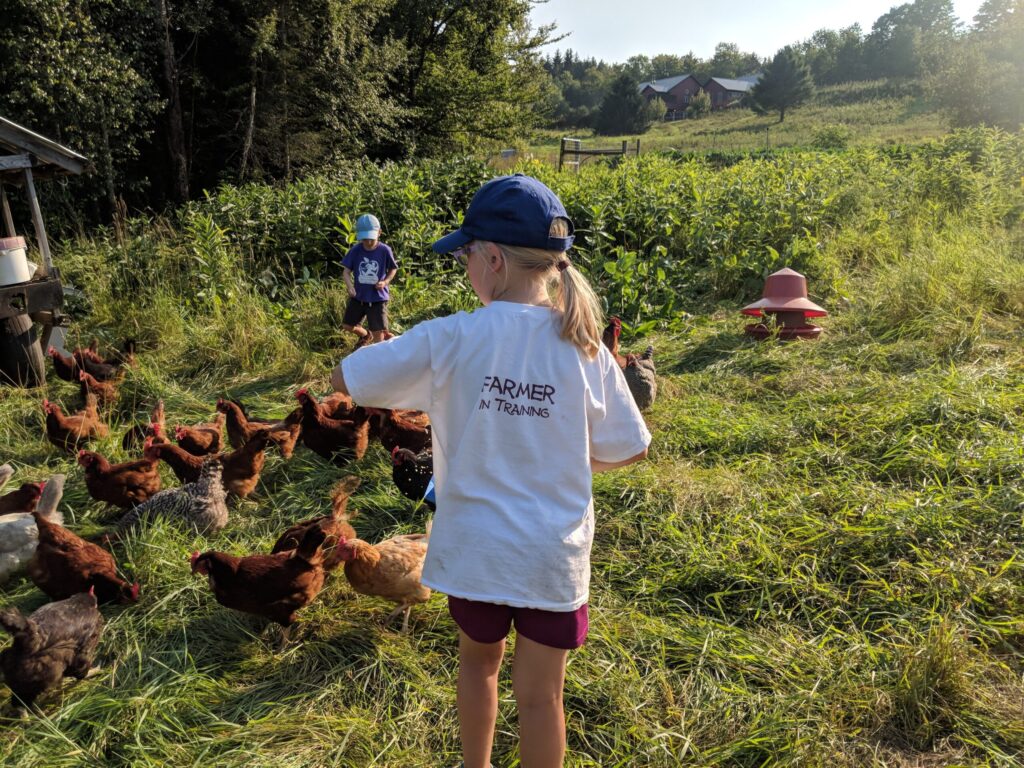
“We get a lot of multi-generational groups that come,” Laura explains. “Often it is that somebody had a parent, a grandparent, an uncle who still farmed, and they remember it. They’ll bring their kids or grandkids because they want the younger generations to be able to reconnect to that and to experience a little bit of what they experienced in their past.”
Those moments matter because they create something increasingly difficult to find: genuine connection. Laura sees it in visitors’ faces. “You can see the light bulbs go on. You can see the joy or the surprise. People tell us, ‘I haven’t tasted chicken that tasted like chicken since I was a child.'” Those are the moments she treasures most. “You know you’ve connected. You know that you’ve fed them something that they may not have even known they needed.”
“People see the scenery. They don’t always see the work”
For many visitors, Vermont is postcard-perfect. Covered bridges. Rolling hills. Forests of maple and aspen that glow red and gold in the fall. Laura loves the prettiness of her home state too, but hopes travellers leave with a deeper appreciation for the people who shape them every day. “I think Vermont’s working lands are underrated,” she says. “People see the beautiful backdrop but forget about the farming, the forestry, the woodworking — all the work that’s happening there. I think what it takes for those who are working the land often gets underappreciated.”
It’s clear that this way of life — sewing, growing, looking after the land — has well and truly got under Laura’s skin. It’s not just a vocation for her, it’s a worldview that extends beyond just Vermont Asked where she’d most like to travel next, Laura doesn’t mention famous landmarks or bucket-list cities. “My first desire is always other farms”, she laughs. She lights up talking about regenerative agriculture in the Great Plains, Indigenous land management practices and smallholder farms across the world. “So many people feed their communities from small farms,” she says. “There’s so much to learn. And in learning, there’s hope.”
“It’s better to be kind than right”
Spend time with Laura and one thing becomes obvious: hope is is what fans her flame. But the way she uses the word is not as an airy, fatalistic notion — it’s rooted in practicalities. It’s found in healthy soil, happy animals, shared meals and conversations that encourage curiosity. It’s the light that she sees in a stranger’s eyes when they pull their first carrot from the soil, the innate kindness that children show towards her animals. In fact, she believes kindness has become one of the most valuable skills any of us can practise. “It’s better to be kind than right”, she likes to say.
Recently another phrase has found its way into her life after hearing it in a graduation speech. “Guard your heart — and take your people with you.” It’s an idea that seems to echo across Green Mountain Girls Farm. Here, the land is cared for collectively. Meals are shared generously. Knowledge is passed from one person to another without urgency or fanfare.
The Green Mountain Boys helped define one chapter of Vermont’s history — now Laura hopes the Green Mountain Girls can contribute to another, where healthier farms, healthier food and healthier communities grow together, season after season.